
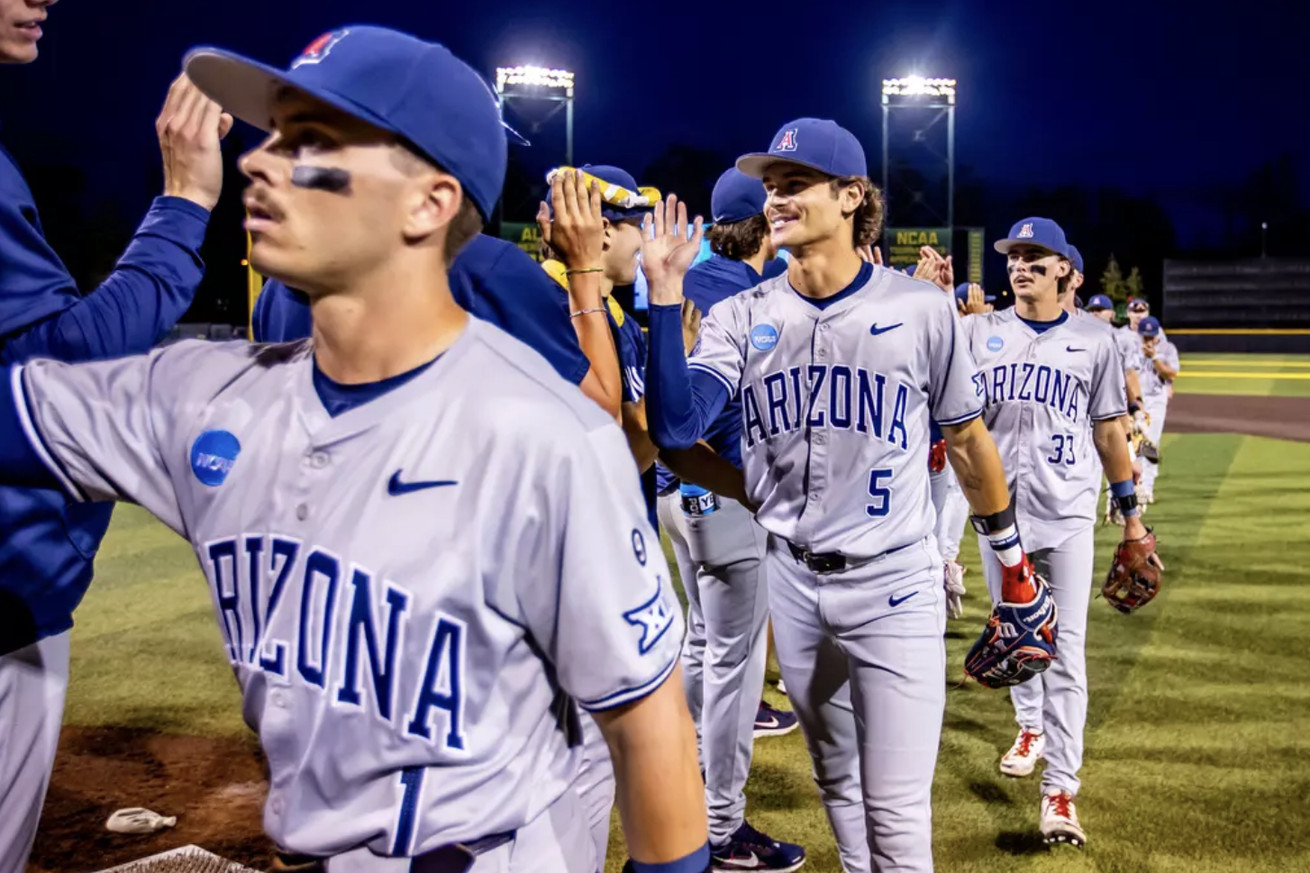
Picked to finish second in its debut season in the Big 12 and ranked in all the preseason polls, Arizona entered 2025 with lofty expectations, internally and externally.
A terrible first weekend may have altered the outside perception, as you might expect after three high-profile losses by a combined score of 31-7. But not on the inside.
“The message hasn’t changed since the very beginning,” centerfielder Aaron Walton said Sunday night, after the Wildcats won the Eugene Regional. “We’ve got a special group. I think as we continue to go through this it should be a lot of fun. I’m excited to see where we end up.”
Arizona (42-18) will face North Carolina (45-13) in its first Super Regionals since 2021, the last time it made the College World Series, with a team built for a deep postseason run. That’s how Chip Hale and his staff felt when assembling a nonconference schedule that would include two tournaments in Texas against ranked teams from the ACC and SEC.
“We try to play and challenge them,” Hale said. “That’s why we wanted to play those six games in Dallas and then in Houston, and see what we got. It slapped us in the face a little bit. We probably thought we were a little better than we were at that point. It got us back working and then we really got going after that.”
The UA lost a 2-1 game to Ole Miss before in its season opener getting blown out by Clemson and Louisville at the Shriners Children’s College Baseball Showdown at Globe Life Field in Arlington, Texas. Two weeks later it went to Houston to face a gauntlet of SEC schools including last year’s CWS finalists and came away from the Astros Foundation College Classic 2-1.
Of those six teams, five made the NCAA Tournament with two advancing to Super Regionals and two others hosting regionals. Arizona also played four games (winning three) against Big 12 regular season champ West Virginia, which also made the Supers.
Yet none of the experience gained from facing quality competition would have mattered had Arizona bowed out in the first weekend of the postseason like the previous three seasons. The Wildcats entered this NCAA tourney on a 5-game regional skid, its longest since 1993-2003 under three different coaches, and a year ago went 0-2 as a host.
“Last year was definitely a disappointment,” third baseman Maddox Mihalakis said. “We had such a great season, and I think it left a sour taste in a lot of the mouths of the people who came back. And I think that this year we kind of just played with that extra chip on our shoulder, coming here in this regional, kind of going down the final stretch of the year. We really turned it on, and we played our baseball, and we just kind of put our best foot forward every day. Being able to come out here with success is great. It’s awesome to be able to keep going.”
A 10-game win streak followed the Houston trip that included a marathon 16-inning win at West Virginia. After taking two of three in Morgantown the Wildcats were 18-5.
But in the final game of that trip it lost right fielder Brendan Summerhill to a broken hand, an injury that would cost him a month. He homered on the first pitch he saw after his return but the next game saw him pull a hamstring and miss another week.
Arizona mostly weathered the first absence, going 12-5, but the second injury occurred early in a series loss at Texas Tech that started a backslide. The Wildcats dropped five of six, dropping a home series to last-place Utah and then dropping the opener at Houston.
At 34-18, Arizona was no longer in consideration to host a regional and its spot in the NCAA tourney may have been in doubt with a few more losses.
“I wouldn’t call that rock bottom for the season, but it felt … we’re like, dang, are we even going to make a regional?,” second baseman Garen Caulfield said last week. “Like, what’s going on? We’re supposed to host one day, and then now it’s like, we’re on the bubble.”
Since then, Arizona has won eight in a row—the second-longest active win streak in the country behind Coastal Carolina’s 21-game run—and outscored its opponents 71-16. Two of those were 1-run games, including the Big 12 Conference Tournament final and the regional opener, and three were decided by 10 or more runs.
“Baseball, it’s a weird sport,” Mihalakis said. “You can go out and play two teams, same team twice, one game is going to be close another game you blow them out. We just kind of showed that here. I feel like if the approach stays the same the whole time, that’s what our team is, and we’re resilient. Go out and find a way to win every day.”